
H.O.T. GUIDE
Health
Occupations
&
Technology
Orthotist and Prosthetist
To be a successful Orthotist and Prosthetist you should…
- possess a desire to help people with disabling conditions
- have a strong sense of aesthetics
- have good eye/hand coordination and precision
- have manual dexterity and patience for minute details
- possess mechanical ability, craftsmanship, and sculpting skills
- have good listening skills and the ability to communicate clearly
Click here to view video.
What will my job be like?
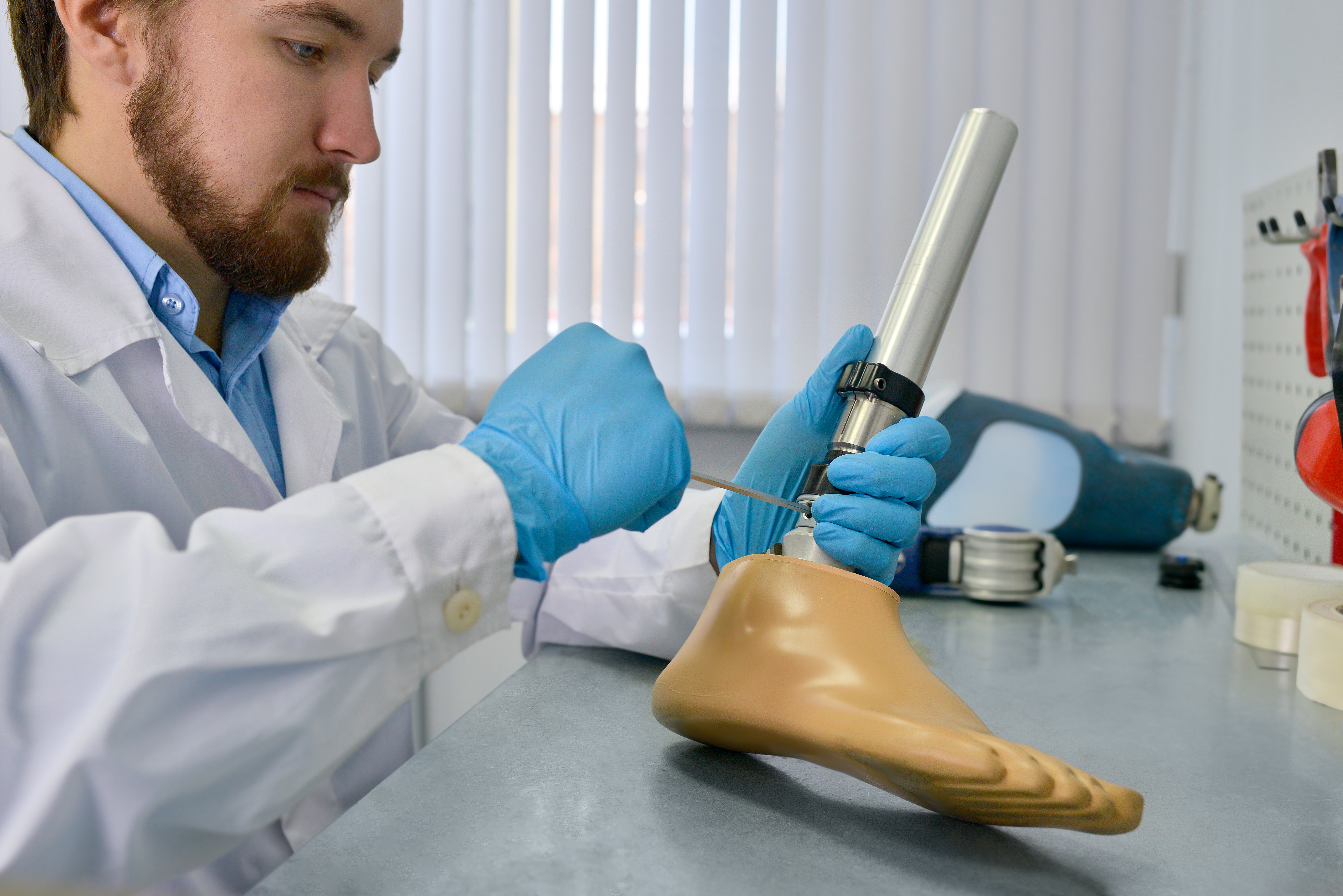
Prosthetists and orthotists tailor-make artificial limbs and devices for missing body parts and deformities. These creative professionals are capable of finding solutions for each patient’s unique physical problem. Orthotists fit corrective shoes, support braces, and strengthening devices to assist in rehabilitation. Designing, making, and adjusting artificial limbs are the challenges of the prosthetist. They also make a special type of device that uses the patient’s own muscle stimulation to make it move in a more life-like manner. New technology, lightweight materials, and the use of computer-aided design make this a career with many exciting possibilities.
Where could I work?
An orthotist and prosthetist may work in rehabilitation centers or privately owned facilities.
Other workplace settings:
- Laboratories
- Hospitals
- Government Agencies
What is the average annual salary?
$78,100
What is the future of this career?
Employment of orthotists and prosthetists is projected to grow 15 percent from 2023 to 2033, much faster than the average for all occupations.
About 800 openings for orthotists and prosthetists are projected each year, on average, over the decade. Many of those openings are expected to result from the need to replace workers who transfer to different occupations or exit the labor force, such as to retire.
What type of education and/or training do I need?
A bachelor’s degree in orthotics and prosthetics, or a bachelor’s degree and a post-graduate certificate in orthotics and/or prosthetics is necessary to enter this profession and a one-year clinical residency per discipline.
Where can I get the education and/or training?
- University of Hartford, West Hartford
Do I need a license or certification for this career?
Licensure is not required in the state of Connecticut.
Where can I get more information?
American Orthotic and Prosthetic Association
330 John Carlyle Street, Suite 200
Alexandria, VA 22314
(571) 431-0876
www.aopanet.org
National Commission on Orthotic and Prosthetic Education
330 John Carlyle Street, Suite 200
Alexandria, VA 22314
(703) 836-7114
www.ncope.org