
DENTISTRY
Dental Hygienist
To be a successful Dental Hygienist you should...
work well with others; have good manual dexterity; have good listening skills; have good eye/hand coordination and precision; have visual acuity noting details in color/shape; have the ability to calm nervous patients; have good aptitude for science coursework; have good health, personal neatness and cleanliness.
What will my job be like?
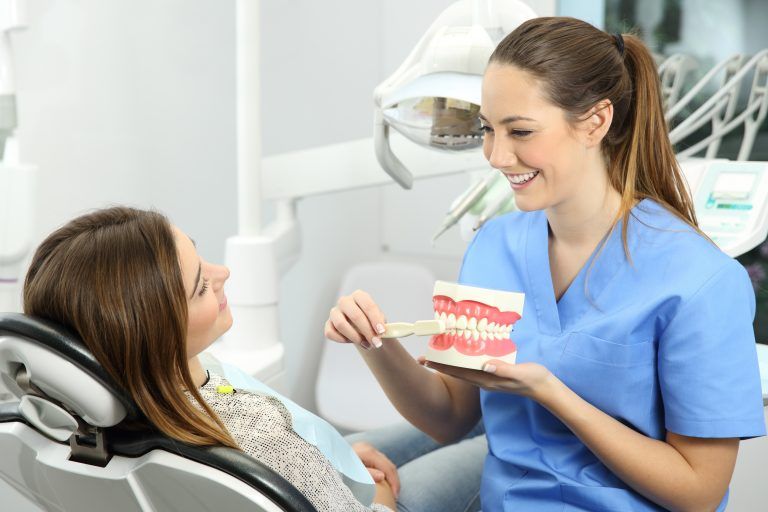
Dental Hygienists use a variety of personal and clinical skills to motivate and instruct patients on ways to prevent oral disease and to maintain oral health. Hygienists perform oral health assessment and oral health instruction. They examine head, neck, and oral regions for disease, take and process x-rays, perform other diagnostic tests, remove deposits from teeth, and apply sealants and fluoride to prevent decay. Dental hygienist may work in periodontic or pediatric dentistry.
Where could I work?
Hygienists are usually employed in dental offices and clinics. Flexible scheduling is a distinctive feature of this job. Full-time, part-time, evening, and weekend work is widely available. Dentists frequently hire hygienist to work two or three days a week, so hygienists may hold jobs in more than one dental office. Depending upon the level of education and experience achieved, dental hygienists can also apply their skills and knowledge to other career activities such as teaching hygiene students in dental schools and dental hygiene education programs.
Other workplace settings:
- Community Health Agencies
- Correctional Facilities
- Hospitals and Nursing Homes
- Military
- Public Health Departments
Average Annual Salary
$87,530 per year
What is the future of this career?
Employment of dental hygienists is projected to grow 9 percent from 2023 to 2033, much faster than the average for all occupations.
About 16,400 openings for dental hygienists are projected each year, on average, over the decade. Many of those openings are expected to result from the need to replace workers who transfer to different occupations or exit the labor force, such as to retire.
Type of Education/Training
Dental hygienists receive their education through academic programs at community colleges, technical colleges, dental schools, or universities. The majority of community college programs take two years to complete, with graduates receiving a diploma, certificate, or associate degree. An associate degree is sufficient for practice in a private dental office. A bachelor’s or master’s degree is usually required for research, teaching, or clinical practice in public or school health programs.
Where could I get the education/training?
- CT State Tunxis
- Goodwin University
- University of Bridgeport - Fones School of Dental Hygiene
- University of New Haven
Licensing/Certification
Licensure is required in the state of Connecticut. Prerequisite: Connecticut requires successful graduation from an approved dental hygiene school and passing the National Board Examinations and Regional Clinical Performance Examination.
More Information
American Dental Association
211 East Chicago Avenue
Chicago, IL 60610
312-440-2500
www.ada.org
American Dental Hygienist' Association
444 North Michigan Avenue, Suite 400
Chicago, IL 60611
312-440-8900
www.adha.org